
About this guide
This guide explains what to expect when hiring a professional wasp pest control company in the UK — species identification, why DIY approaches fail, how a qualified technician treats a nest, what qualifications to look for, and what happens on the day and after treatment. It covers the public health risk from wasp stings, the Asian hornet notifiable species obligation, and treatment timing. The page supports Apex Pest Control Ltd's wasp nest removal information by answering common questions before users choose a professional pest control service.
The Two Main UK Wasp Species — Common Wasp and German Wasp
The two species responsible for almost all professional wasp nest treatments in the UK are the common wasp (Vespula vulgaris) and the German wasp (Vespula germanica). Both are eusocial — colonies are founded each spring by a single overwintered queen who builds an initial paper nest from chewed wood fibre. The colony grows through summer to peak at 3,000–8,000 workers by August or September. The colony dies in autumn when the first frosts kill all workers; only newly mated queens survive by hibernating to start new colonies the following spring.
Common Wasp (Vespula vulgaris)
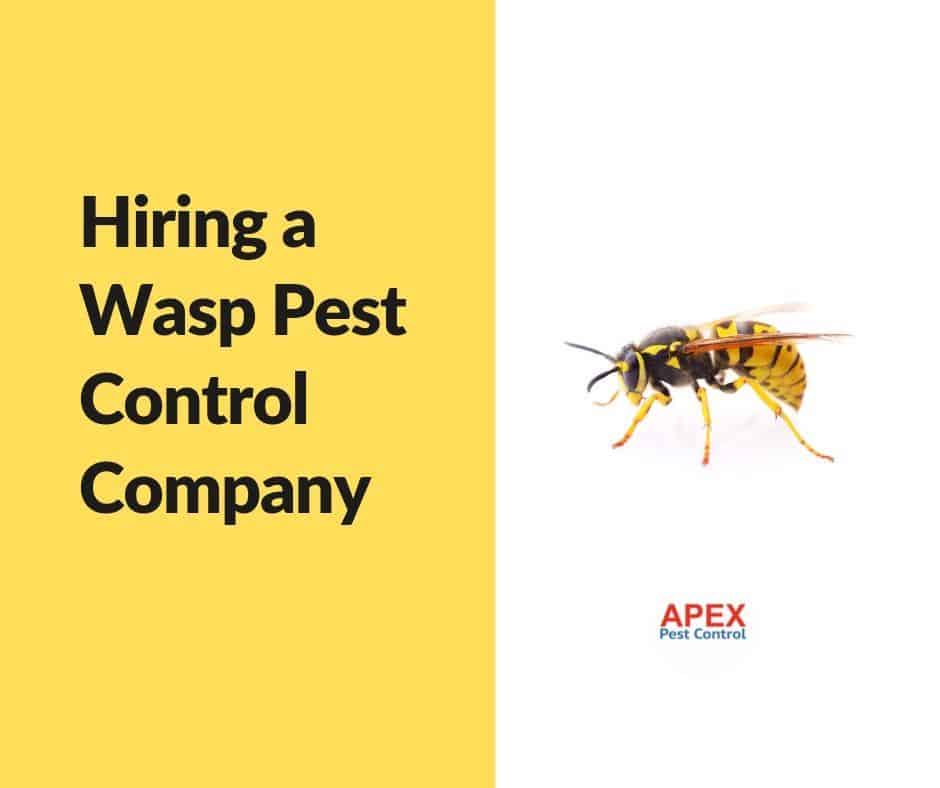
Workers are 11–14 mm; queens 17–20 mm. Yellow and black banded abdomen. The diagnostic field identification feature is the anchor-shaped (or dagger-shaped) black marking on the yellow clypeus (face shield). This distinguishes it from the German wasp, which has three separate spots on the clypeus rather than an anchor shape. Common wasps build nests underground in disused burrows, in roof voids, wall cavities, garden sheds, and bird boxes. In early to mid summer they forage primarily for protein (insects and caterpillars) to feed larvae; in late summer, as larval secretion of carbohydrates slows, workers shift to active sugar-seeking — the familiar nuisance behaviour around outdoor dining and food.
German Wasp (Vespula germanica)
Similar in size and appearance to the common wasp. The three-spot clypeus pattern is the key distinction. German wasps tend to build larger colonies and are more commonly found in roof void nests. Treatment approach for both species is identical — a qualified technician confirms the species as part of the site assessment but the treatment protocol does not differ significantly between the two.
Asian hornet — notifiable species: The Asian hornet (Vespa velutina) is an invasive alien species under the Invasive Alien Species (Enforcement and Permitting) Order 2019 and must not be treated by private pest controllers without APHA authorisation. Any suspected sighting must be reported immediately to APHA. The Asian hornet is darker (almost entirely dark brown-black) with a yellow-orange face, yellow-tipped legs, and a single orange abdominal band — very different from the common wasp's multiple yellow-black bands.
Why Professional Wasp Pest Control Is the Only Safe Approach
Common wasps can sting repeatedly — unlike honey bees, the wasp sting is not barbed in the same way and is not lost on use. A disturbed colony mobilises within seconds of a perceived threat, with alarm pheromone released by stinging workers recruiting additional defenders. An established colony in late summer may contain several thousand workers.
UKHSA and NHS data indicate wasp and bee sting anaphylaxis is responsible for approximately 2–9 deaths per year in England (variable by year); non-fatal anaphylactic reactions requiring A&E attendance are more common.
— UKHSA; NHS clinical guidance
Professional pest controllers carry out approximately 300,000 wasp nest treatments across Great Britain every year — wasp control is the second most common reason for professional pest control callout after rodents.
— BPCA (British Pest Control Association)
Consumer insecticide sprays fail against established nests for two consistent reasons: the product volume is insufficient to penetrate nest chambers, and disturbing the entrance without professional PPE triggers an immediate defensive mass-sting response. A qualified technician carries full protective equipment, uses professional-grade BPR-approved insecticide products, applies at dusk when workers have returned to the nest, and is trained in safe approach and application methods.
One critical safety point: never attempt to seal the nest entrance before or during treatment. Workers trapped inside become concentrated and highly aggressive — and may find alternative exit routes into living areas. The entrance must remain open throughout treatment to allow workers to contact the insecticide and carry it into the nest.
How a Professional Wasp Pest Control Company Treats a Nest
A qualified technician begins with a site assessment to confirm the nest location, species, and access route. Correct identification is important — any nest suspected to be Asian hornet must be reported to APHA rather than treated by a private pest controller.
Treatment Method
For accessible nests, the established professional treatment is a synthetic pyrethroid insecticide dust — typically permethrin or deltamethrin — applied with a bellows duster or extended lance directly into the nest entrance. Workers carry the dust into the nest on contact and spread it through the colony; the nest is typically dead within 24–48 hours. Expanding foam insecticide formulations are used for wall cavity or roof void nests where dust penetration may be limited, delivering the active ingredient through the nest entrance and adjacent void space.
Treatment is most effective when carried out at dusk or night, when workers have returned to the nest and the number of flying workers is at its lowest — reducing both sting risk and insecticide wastage.
Treatment Timing and Colony Size
Early treatment — May to June — addresses a smaller colony with lower worker numbers. Less insecticide is required and the treatment risk is lower. By August or September, a nest at peak size may contain 3,000–8,000 workers; treatment of a large late-season colony requires higher PPE standards and greater caution, but remains straightforward for a qualified technician. The nest does not need to be physically removed — once the colony is dead, the structure will not be reused. Most treatments require a single visit, though heavily infested loft voids or underground nests may benefit from a follow-up check 5–7 days later.
Qualifications to Expect From a Wasp Pest Control Company
Before booking, confirm that the technician holds one or more of the following: RSPH Level 2 Award in Pest Management, BPCA Certificate of Competence in Pest Management, or equivalent qualification from a recognised awarding body. Membership of the BPCA or NPTA provides an additional quality assurance benchmark — member companies are subject to professional standards and code of conduct requirements.
All insecticide products used must hold current UK Biocidal Products Regulation (BPR) approval with a use pattern that includes wasp nest treatment. The technician should carry public liability insurance. Asking these questions before booking distinguishes qualified professionals from unqualified operators — a meaningful distinction when the job involves aggressive insects at height or in difficult access situations.
What to Expect on the Day — and After Treatment
Keep the area around the nest clear of children and pets for the duration of the treatment and for at least 2–4 hours afterwards. Activity at the nest entrance will increase immediately after treatment as returning workers contact the insecticide — this is normal behaviour and typically settles as the insecticide takes effect over the following hours. The nest entrance may remain active for up to 24 hours post-treatment as the colony is progressively incapacitated.
After 48 hours the nest should be completely inactive. Do not attempt to remove the dead nest yourself — the structure is fragile, any remaining insecticide residue should not be handled without PPE, and some individuals may still be alive within the structure for a short period after treatment ceases. The nest will break down naturally over autumn and winter. For a nest in a roof void or other enclosed space, removal may be arranged once the colony is confirmed dead.
For professional wasp nest treatment across Sheffield, Leeds, Barnsley and Rotherham, contact Apex Pest Control Ltd. All treatments are carried out by BPCA-certified, RSPH Level 2 qualified technicians using professional-grade BPR-approved insecticide. For guidance on preventing wasps from nesting in the first place, see our guide on wasp deterrence and property proofing.
Frequently Asked Questions
How long does a professional wasp treatment take?
The on-site treatment typically takes 15–30 minutes depending on nest access. The colony will be dead within 24–48 hours. A follow-up visit may be arranged for complex cases such as underground nests or large loft infestations.
Do wasps come back after treatment?
The treated nest will not be reused by wasps — a dead colony does not attract a new queen. However, a new queen may independently choose to build a nest in the same location the following year if the site offers suitable conditions. Proofing the entry point after treatment prevents this.
What is the difference between Common and German wasps?
Both species form annual colonies and behave similarly. The Common wasp has an anchor-shaped facial marking; the German wasp has three dots. German wasp nests tend to be slightly larger at peak season. Both are treated with the same professional insecticide methods.
Are wasps protected by law?
No. Common wasps and German wasps have no legal protection in the UK. No licence is required to destroy a wasp nest. The restriction on treatment is practical — the sting risk — not legal.
When is it safe to go near a wasp nest after treatment?
Avoid the nest entrance for at least 2–4 hours after treatment while returning workers are still contacting the insecticide. After 48 hours the nest should be completely inactive and the area safe for normal use.
Can wasps come back to a treated nest?
After a nest is treated and the colony dies, returning wasps from other colonies will not rebuild in the same location that season. However, next season a new queen may establish a new nest nearby. Remove the old nest once it is fully dead.
Are wasps beneficial to the environment?
Yes. Wasps are important predators of other insects, helping to control aphid and caterpillar populations in gardens and farmland. However, a nest in a building or roof space that poses a sting risk to occupants warrants professional treatment.
Wasp Nest Treatment Across Yorkshire
For wasp nest treatment in South or West Yorkshire, Apex Pest Control Ltd provides professional wasp nest treatment across Sheffield, Leeds, Barnsley, and Rotherham. All treatments are carried out by BPCA-certified, RSPH Level 2 qualified technicians using professional-grade BPR PT18 insecticide.
Contact Apex Pest Control Ltd to book your treatment.